
The Traditional VC Model - Know The Game
By David S. Williams III, Program Director
To understand the venture capital (VC) model, you have to look at it not just as a source of money, but as a finite financial product. Most VCs are managing a "Closed-End Fund" with a specific expiration date. This creates a countdown that dictates every decision they make about your company.
Here is the traditional model most VC investors follow:
1. The 10-Year Fund Lifecycle
The standard VC fund is structured to last 10 years, often with the option for two 1-year extensions. Because the fund must "dissolve" and return all cash to its own investors (Limited Partners or LPs) by the end of this decade, the timeline for your business is compressed into three distinct phases:
Years 1–3 (Investment Phase): The VC actively finds new companies and writes initial checks. If you are their first investment in a new fund, they have 7–9 years to wait for you to grow. If you are their last, they may only have 5–6 years.
Years 4–7 (Management/Follow-on Phase): The VC stops making new investments and focuses on "following on" (investing more money) into the winners of their current portfolio.
Years 7–10+ (Harvest Phase): The "exit clock" starts ticking loudly. The VC is looking to sell their stake via an acquisition or an IPO to liquidate the fund.
2. Risk Levels and the "Power Law"
VCs do not expect every company to succeed. In fact, they build their model around the Power Law, which assumes that a tiny fraction of investments will provide the lion's share of returns.
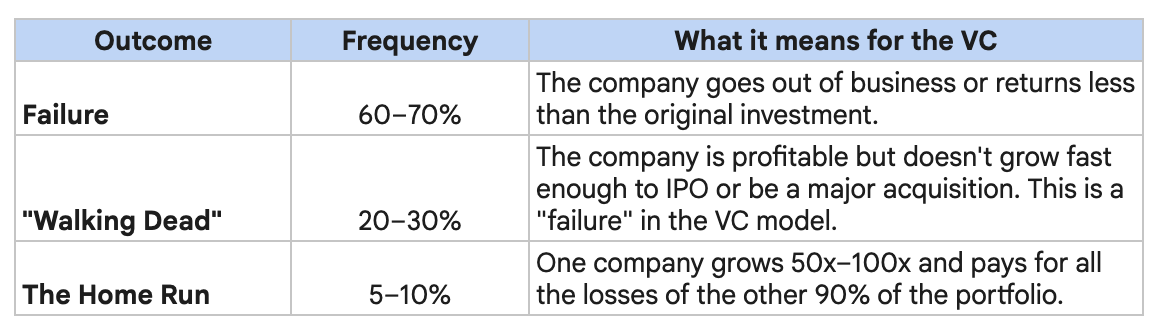
The Entrepreneur’s Risk: Because VCs need "Home Runs," they will often push you to take high-risk "swing for the fences" moves. If those moves bankrupt your company, it’s a calculated loss for their portfolio; for you, it’s your entire business.
3. Return Expectations (ROI)
VCs measure success through Multiple on Invested Capital (MOIC) and Internal Rate of Return (IRR). Their targets depend on what stage they invest in:
Seed Stage: They look for 100x+ potential. Since the risk of failure is highest here, they need the upside to be massive.
Series A/B: They typically look for 10x–15x returns.
Late Stage (Series C+): They look for 3x–5x returns with a much higher probability of success and a shorter path to exit (2–4 years).
4. Overall Exit Timeline
While the fund lasts 10 years, the average time to exit for a successful tech startup is currently 8 to 12 years.
This creates a "liquidity gap." If your company is doing well but isn't ready to sell by year 10 of the VC's fund, they may face pressure to:
Force a sale earlier than you might want.
Sell their shares to another investor (a "secondary sale").
Request an extension from their LPs to wait for your IPO.
Summary Table: The VC Timeline

BONUS: Want to learn how different types of early stage investors make their decisions? Watch our powerhouse VC Panel from OVERLAB Live #2 during LA Tech Week (featuring GCWC Capital, Healthworx Accelerator, and A26 Ventures). You must be an OVERLAB member to access.
* Note: Some contributions from AI